Day One: St Michael’s Mount, Pendennis and St Mawes castle
Your day will start with a brief introduction to each of the castles that we are going to visit and the significance of each.
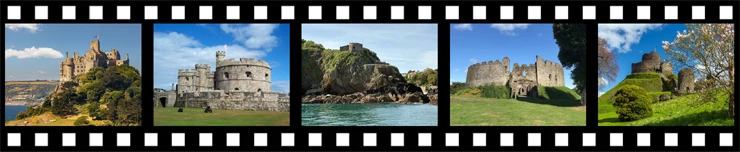
Your tour will start at St Michael’s Mount where, depending on the tide we will walk across the stone causeway or take the short ferry ride. Originally an English counterpart to Mont Saint Michel in Normandy France, St Michael’s Mount was initially the site of a monastery. A castle was built here in the 12th Century.
The Mount has long played a part in England’s turbulent history. John de Vere, the 13th Earl of Oxford, seized and held it during a 23 week siege by King Edward IV's troops in 1473–1474 during the Wars of the Roses. Perkin Warbeck, a pretender to the English throne, occupied the Mount in 1497. Claiming to be Richard of Shrewsbury, one of the Princes in the Tower, he sailed from Ireland to Cornwall to seize the English throne from King Henry VII and used the fortress as his military stronghold.
Sir Humphrey Arundell, Governor of St Michael's Mount, led the Prayer Book Rebellion of 1549. During the reign of Elizabeth I, it was given to Robert Cecil, 1st Earl of Salisbury, whose son sold it to Sir Francis Bassett. During the English Civil War, Sir Arthur Bassett, brother of Sir Francis, held the Mount against Parliamentarian forces from 1642 until July 1646. The Mount was fortified again in the Second World War, during the invasion crisis of 1940–1941.
In 1659 the Mount was sold to Colonel St John Aubyn and 12 generations of the St Aubyn family have lived here since and we can visit the main rooms in the castle, looking at the artefacts which illustrate the journey from monastery to fortified castle to family home.
From St Michaels Mount we travel to Pendennis Castle.
Built by Henry VIII to defend the Cornish shores, this magnificent Tudor fortress has withstood two world wars, a lengthy siege and centuries of coastal drama. Built between 1540 and 1542 to protect against invasion from France and the Holy Roman Empire, it defended the Carrick Roads waterway at the mouth of the River Fal. The castle features beautiful stone carvings of the Tudor royal arms with Latin inscriptions, designed to flatter the monarch and his son Edward. It also has a deep hole, known as an "oubliette." Here prisoners or unruly soldiers were kept in the dark underground as punishment.
During the English Civil War, it was held by the Royalists and was only taken by Parliament after a long siege in 1646. It survived the interregnum under Oliver Cromwell, and Charles II renovated the fortress after his restoration to the throne in 1660.
Pendennis's defences were modernised and upgraded in the 1730s and again during the 1790s; during the Napoleonic Wars, the castle held up to 48 guns.
In the 1880s and 1890s an electrically operated minefield was laid across the River Fal, operated from Pendennis and St Mawes, and new, quick-firing guns were installed to support these defences. In the 19th century, the Grand Sea Battery was built and soon after, the magazine or ammunition store. Today there is a gun on a replica traversing platform to show you how later defences worked to protect the castle.
The castle was rearmed during the First World War but saw no action and was again rearmed during the Second World War when it saw action against the German Luftwaffe intending to bomb Falmouth.
Depending on the season we will then take a three-mile ferry trip across the mouth of the River Fal to visit St Mawes castle. Alternatively, we will go by car on the King Harry Ferry from nearby Feock.
St Mawes Castle was a sister fort to Pendennis. Also built by Henry VIII, both were required to protect the harbour at Falmouth as the cannon at that time could not reach across the harbour entrance.
The castle has a central round tower and three outer bastions all of which were originally used as gun decks. Additional guns were positioned by the shore and there was also a small blockhouse built. It was used until 1920 although, like Pendennis it was re-fortified during the Second World War.
There is a display of big guns in the Field Train Shed and the collection includes Tudor, Napoleonic, Victorian and 20th-century guns, each with information on how they would have been used.
We finish the day by checking into your hotel – the Idle Rocks Hotel at St Mawes.
Day Two: St Catherine’s Castle Fowey, Castle Dore and Restormel Castle
Day two will start with a drive to Fowey arriving first at St Catherine’s Castle. This is another of those castles built by Henry VIII, this time to defend the entrance to Fowey Harbour on the River Fowey. The river is only about 230 metres wide at this point, making any ships attempting to enter the harbour an easy target for the castle’s guns.
The castle builders excavated areas of bedrock to create platforms for the fort’s structures, which has three main elements: an upper gun tower (the ‘castle’), a gun platform below it (the ‘lower battery’) and a defensive wall. This wall reached right across the headland north-east and south-west from the gun tower, to make the whole castle defensible against a landward attack.
It was modified in the 19th century during the Crimean War and again during the Second World War, when it became home to an anti-aircraft gun and an ammunition store.
Having looked around St Catherine’s Castle we will then travel a short distance north to Castle Dore, a completely different experience! Castle Dore is an Iron Age hill fort probably occupied from the 5th or 4th centuries BC until the 1st century BC. In tradition Castle Dore was the seat of the legendary Dark Age King Mark of Cornwall and is featured in the 2006 film Tristan & Isolde.
During the English Civil War, the final defeat of the Duke of Essex's Parliamentarian Army took place at the site. On 31 August 1644, whilst attempting a retreat from Lostwithiel to Fowey, Essex was forced to make a last stand within the fort. Attacked on all sides by the Royalist army, Essex chose to flee leaving what was left of his army to surrender.
From Castle Dore we will travel east to Restormel castle at Lostwithiel.
Restormel Castle was built in the 12th Century and the huge and almost perfectly circular castle keep stands on a high and deeply ditched mound overlooking the river Fowey. Baldwin fitz Turstan, son of the sheriff of Cornwall at the time of the Domesday survey (1086), is said to have established the first castle on the site.
With links to Simon De Montford and Edward the Black Prince, the castle’s closeness to Lostwithiel, a key site for the administration of the Stannaries – the regional organisations regulating the important tin industry in Cornwall – gave it considerable economic importance.
We will be able to trace the layout of the once-luxurious royal apartments used by Edward, the Black Prince, during his visits in 1354 and 1362. You can still see the remains of the Great Hall, kitchens, and large fireplaces.
There is also the castle chapel which projects outward from the main wall. It was used as a place of worship and was later modified into a gun emplacement during the English Civil War. As with Castle Dore, Restormel was briefly occupied by the Earl of Essex’s forces during the English Civil War. This was the last time Restormel functioned as a castle. Afterwards it was to become known as a historical curiosity and a feature in the landscape. It became something of a tourist attraction, visited by, among others, Queen Victoria and Prince Albert, in 1846.
We will then travel north crossing the rugged Bodmin Moor with its relics of the Cornish tin mining industry to Tintagel where you will stay at the Camelot Castle Hotel.
Day Three: Tintagel Castle and Launceston Castle
Day three starts with a visit to the legendary Tintagel Castle. Tintagel Castle is one of the most spectacular historic sites in Britain, associated with the mythical King Arthur which so makes it one of the most famous.
From about the 5th to the 7th century AD it was an important stronghold, and probably a residence of the old rulers of Cornwall. It was probably memories of this seat of Cornish kings that inspired the 12th-century writer Geoffrey of Monmouth to name it in his ‘History of the Kings of Britain’ as being the place where King Arthur was conceived, with the help of Merlin. At the same time, Cornish and Breton writers linked the love story of Tristan and Isolda with Tintagel.
These connections led the hugely rich and ambitious Richard, Earl of Cornwall, to build a castle here in the 1230s. The site was of no military value – legend alone seems to have inspired him to build here.
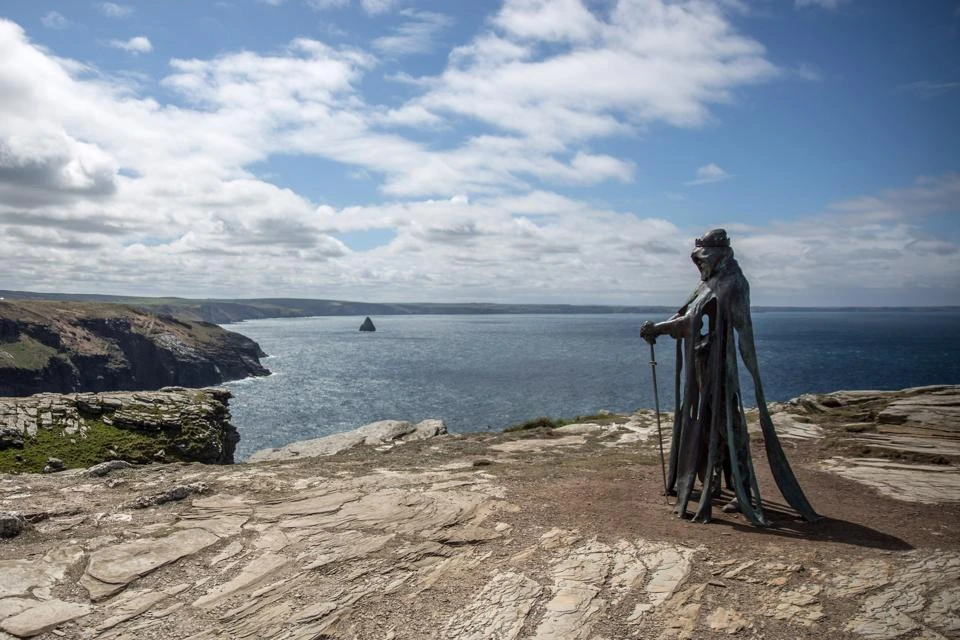
The castle's ruins stand partly on the mainland and partly on the island. In medieval times the two halves were connected by a bridge. A spectacular modern footbridge, providing unforgettable panoramic views of the Atlantic, now connects the two. At the castle we can also meet Gallos - a brooding bronze statue created by artist Rubin Eynon, standing on the headland and inspired by the ancient kings of Cornwall.
From Tintagel we will travel back across the moor to Launceston. Here we will visit Launceston Castle. Built in the 13th century, Launceston Castle once controlled the main route into Cornwall. Today it still offers magnificent far-reaching views from the stone keep.
The castle was captured by the rebels during the Prayer Book Rebellion of 1549 and was garrisoned by the Royalists during the English Civil War. Towards the end of the civil war, it was stripped for its building materials and rendered largely uninhabitable.
However a small jail was erected in the centre of the castle bailey, which was also used for executions and the castle eventually became the county gaol for Cornwall. It was heavily criticised for its poor facilities and treatment of inmates, earning it the nickname ‘Castle Terrible’.
In the mid 1800’s the prison was closed and remaining prisoners moved to Bodmin Jail, another notorious place where, in 1909, William Hampton was hanged for the murder of his 17-year-old girlfriend. He was the last person to be hanged in Cornwall. In recent years the prison has been turned into a luxury hotel – you can now spend what might turn out to be a restless night in one of the former cells!
At the castle there is an exhibition room for artifacts, including a rare whale vertebra that hints at high-status medieval feasting.
From Launceston we will travel over the border to Devon and en-route your guide will explain the Great Scone Debate – cream first or jam first?!
We will travel to Oakhampton where we will visit Oakhampton Castle. The castle covers a wooded ridge guarding a crossing over the West Okement river. It is an example of a motte and bailey castle, one of the early forms of castles built after the Norman invasion of Britian in 1066.
In the 14th century, Hugh Courtenay developed it into a palatial home. We will explore the remains of his buildings, which stretch from the keep mound to the tall gatehouse.
The last owner of the castle, Edward Courtney, seriously fell foul of Henry VIII who executed his son Henry in 1539, and the castle was abandoned. Later its picturesque ruins became an inspiration for J M W Turner who painted it in 1824 and other Romantic painters of the time.
From Oakhampton we will then travel to Exeter where you will stay for the night at the Southernhay House Hotel, a former Georgian town house, originally owned in 1805 by Captain William Kirkpatrick who enjoyed a brilliant career in the East India Company, He was in fact the first European to reach Nayakote in Nepal, where the Nepalese Rajahs then held court.
The next morning you will say goodbye to your guide and catch a train back to London.